 24/7 SUPPORT

It’s rare that a security system fails all at once. For most pharma facilities, the security devices age, sometimes not so gracefully. Cameras get a little grainier, a door controller triggers more false than real alarms, a security incident report takes a little longer to pull, or an auditor asks a question your system can’t answer.
When is the right time to replace the system? Or better yet, can it simply be upgraded? And, most importantly, what will this cost and how long will it take? The short version: modernizing physical security for a pharma environment is likely less disruptive and less costly than you expect, many systems aren’t being used to their greatest ability, and the newest layer of technology, AI-assisted monitoring, can move your team from reviewing what happened to catching what’s about to.
Why pharma security carries a different weight
Most commercial buildings secure doors and parking lots. Pharmaceutical facilities secure chain of custody. Controlled substances, investigational products, finished goods, and sensitive research all move through spaces that need defined, enforceable, and provable access rules.
That last word matters. Regulatory frameworks such as DEA security requirements for controlled substances, FDA current good manufacturing practice (cGMP) expectations, and Drug Supply Chain Security Act (DSCSA) obligations all depend on your ability to show who accessed what, when, and under what authority. A security system in this industry is part of your quality system. If it can’t produce a reliable audit trail, it is a compliance gap, whether or not anything has gone wrong.
Pharma sites also face risks that don’t always make headlines: insider access that is broader than it should be, contractors and visiting auditors moving through controlled zones, diversion of product, and intellectual property walking out in a bag instead of over a network. Strong physical security addresses all of these, and it’s an area where older systems can fall short. Supply chain integrity is also a concern, and you can read more about that here.
Upgrading is not the same as replacing
The most common assumption we’ve heard over years of working with facilities in Indiana, Virginia, Ohio and Kentucky is that modernizing security will mean ripping out everything and rebuilding. Often, it doesn’t.
Many facilities can modernize in phases:
- Keep what still works. Quality door hardware, cabling, and some cameras and controllers often have years of useful life. An assessment can separate what is truly obsolete from what is simply old.
- Upgrade the brains before the body. Moving to a modern, open-platform access control and video management layer can bring older devices into one interface and extend their life.
- Prioritize by risk. Start with the areas that carry the most regulatory and operational weight, such as controlled substance storage, cleanrooms, receiving and shipping, and research spaces, then expand on a schedule that fits your budget cycles.
- Plan around production. In a facility where downtime is expensive and some areas can’t be casually entered, phased installation and careful scheduling are part of the design, not an afterthought.
A phased approach also helps with budgeting. Spreading an upgrade across fiscal periods is often easier to approve than one large capital request, and it lets you show results at each stage.
Where AI earns its place
AI in security is mentioned often, sometimes too often, but it does save time and make work sites safer in a number of ways. Modern video analytics don’t replace your people. They handle the part of the job that people can’t sustain: watching dozens or hundreds of camera feeds with unwavering attention.
In a pharma setting, that can look like:
- Alerts on unusual activity in restricted areas, such as someone lingering at a controlled-substance cage, entering a zone after hours, or tailgating–following another person through a door without badging.
- Faster investigations. Instead of scrubbing through hours of footage, search by event type, time, or area to find what you need in minutes.
- Pattern recognition across systems. When access control events and video are connected, a door forced open, a badge used in an unexpected sequence, or a held-open door can trigger a response while it is still happening.
- Occupancy and flow awareness that supports both safety and operational planning.
The shift is from reactive to proactive. Traditional systems are excellent witnesses; they tell you what happened. An AI-enabled system integrated with access control can act more like an incredibly alert and detail-oriented colleague who taps you on the shoulder before the situation develops. Because physical security carries real consequences, these tools should be tuned to your environment and reviewed by your team, so alerts are meaningful rather than noisy.
Compliance: design for the audit you haven’t had yet
The strongest compliance posture comes from building documentation into the system itself. When evaluating an upgrade, look for:
- Granular, role-based access that maps to your zones and can be changed quickly when people change roles or leave.
- Complete, tamper-resistant audit trails for door events, credential changes, and administrator actions.
- Video retention that matches your policies, with the ability to export evidence cleanly.
- Door hardware that matches the risk, including appropriate locking, monitoring of door position, and alarms for propped or forced doors on high-control spaces.
- Visitor and contractor management that issues temporary, expiring, area-limited credentials rather than relying on escorts alone.
- Reporting that is easy to produce so audit preparation is a report run, not a project.
The point isn’t to chase every checkbox. It’s to make sure that the next time an inspector, a corporate quality team, or a client auditing your site asks for evidence, it’s easy to access and produce.
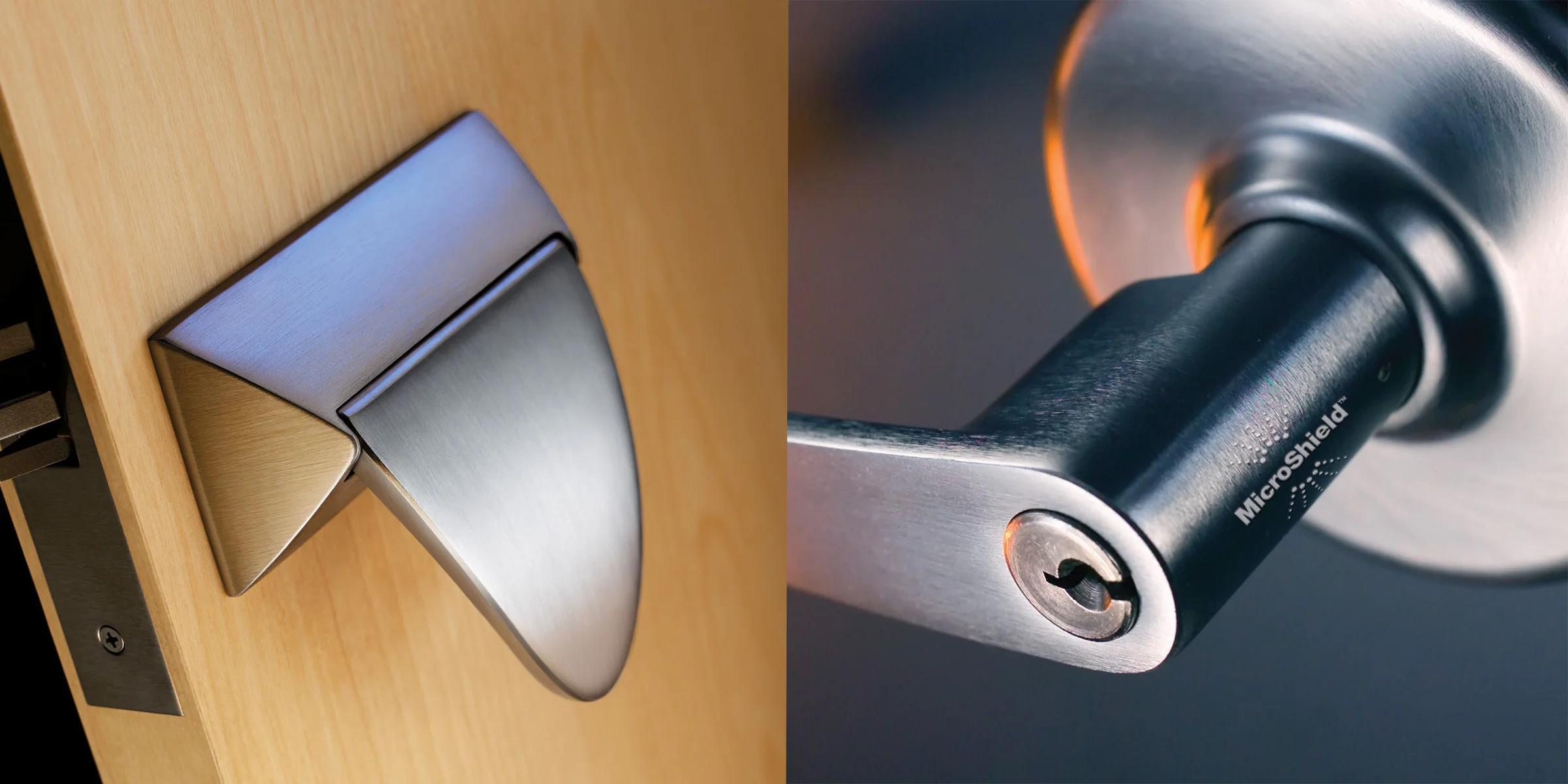
Photos courtesy of Assa Abloy
Door hardware: a clean exit (and entrance)
Door hardware at access control openings at pharmaceutical facilities is similar to what you’ll find in hospitals, K-12 schools and universities: electrified locks, exit devices, credential readers and closers. Specifications that have been refined in those high-traffic, tightly controlled environments carry over well, and an integrator who works in them has already solved many of the same problems.
One option that we see our pharma clients using is antimicrobial door hardware. Food and drug facilities sometimes install it to help reduce the spread of bacteria on high-touch surfaces. Data Link preferred vendors offer silver-ion coatings on levers, locks, exit devices and, in some cases, readers. The coating is designed to inhibit bacterial growth by interrupting cell multiplication.
The evidence is worth reading with a clear eye. ASSA ABLOY, one of our partners, did a test at Tanner Medical Center in Georgia, where a high-traffic door handle showed 26 bacterial colonies. Two weeks after it was replaced with a coated handle, the front showed no growth and the underside showed one colony. It resulted in Tanner mandating coated hardware into its specifications for renovations and new construction.
This is all said with the understanding that the coatings are not a substitute for hand washing and regular cleaning, and neither guarantees efficacy. It’s best to see it as an added layer and confirm that the finish is compatible with your cleaning and disinfection protocols and with your quality team’s requirements. An upgrade, when hardware is already under review, is a low-cost moment to ask the question.
A quick gap check for your current security system
If you’re unsure whether you need an upgrade, a repair, or nothing at all, these questions can help you decide:
- On average, how long does it take to pull a complete access history for a specific room and date range?
- Do your cameras capture clear detail at doors, cages, and loading areas, day and night?
- Are former employees and expired contractors manually removed from access or do their badges inactivate automatically?
- Are access control and video connected, so an event at a door brings up the right camera automatically?
- Do you know which devices are end-of-life or no longer supported by their manufacturer?
- Are there areas where a door can be propped or tailgated without anyone knowing?
- Do you get a lot of false alarms and do people tend to ignore them?
- When something breaks down, how long does it take to get it fixed, and who do you call?
What happens after the install matters as much as the install
That last question deserves its own attention. Security is not a one-time purchase; it is a system that has no option but to work perfectly every day, in a regulated environment, with people who rely on it to do their jobs. A door controller that fails at a controlled-substance room doesn’t just inconvenience someone; it creates a compliance and risk event that needs attention fast.
When you evaluate any security partner, whether you’re replacing a system or simply reviewing your current one, ask what support looks like after go-live:
- Who answers when something goes wrong, and how quickly?
- Do they know your facility, or do you get a different representative each time who’s unfamiliar with your site?
- Is there a plan for firmware updates, preventive maintenance, and periodic reviews of your configuration?
- Will they help you adjust as your operations, staffing, and regulatory expectations change?
A vendor’s responsiveness after installation is one of the clearest indicators of whether a system will still serve you well in five years. At Data Link, that ongoing relationship is a core part of how we work with enterprise healthcare and life sciences-adjacent clients, because a system is only as dependable as the team behind it.
A regional perspective: Indiana, Kentucky, and Virginia, Ohio and South Carolina
The Midwest and Mid-Atlantic corridor is home to a significant concentration of pharmaceutical and life sciences activity. Across the region, organizations such as Bristol Myers Squibb, Elanco, Medpace, and Thermo Fisher Scientific maintain research, manufacturing, and clinical operations, and the broader ecosystem of suppliers, labs, and distribution partners around them is substantial.
Data Link serves enterprise clients across the region, bringing experience from complex healthcare and education environments where access control, video surveillance, and door hardware must work together under real operational pressure. Facilities in these markets share common challenges: multi-building campuses, mixed populations of employees, contractors, and visitors, strict zoning requirements, and teams that are asked to do more with the same headcount. Local presence matters here, because a service call is easier to answer when your integrator is a drive away rather than a time zone away.
Frequently asked questions
Do we have to replace our entire security system to add AI analytics? Not necessarily. Many existing cameras and access control platforms can be integrated with analytics through a modern video management or access control layer. An assessment will show what can be retained and what should be upgraded.
How does physical security support pharmaceutical compliance? It provides controlled access, documented audit trails, and recorded evidence for areas that contain controlled substances, regulated product, and sensitive research, supporting requirements from agencies such as the DEA and FDA.
How often should a pharmaceutical facility review its security system? At minimum, annually, and any time there is a change in layout, operations, staffing, or regulatory scope. A review is also wise after any security incident or near miss.
The takeaway
Upgrading doesn’t have to mean disruption, and it doesn’t have to mean starting over, with big budgets. The real question is whether your current system gives you proof, visibility, and speed: proof of who went where, visibility into what is happening now, and speed in response when something isn’t right. If the answer is uncertain, a free site assessment is a sensible place to begin.